

LICORICE ROOT
Sweet Medicine • Deep Nourishment • Harmonizer of Systems
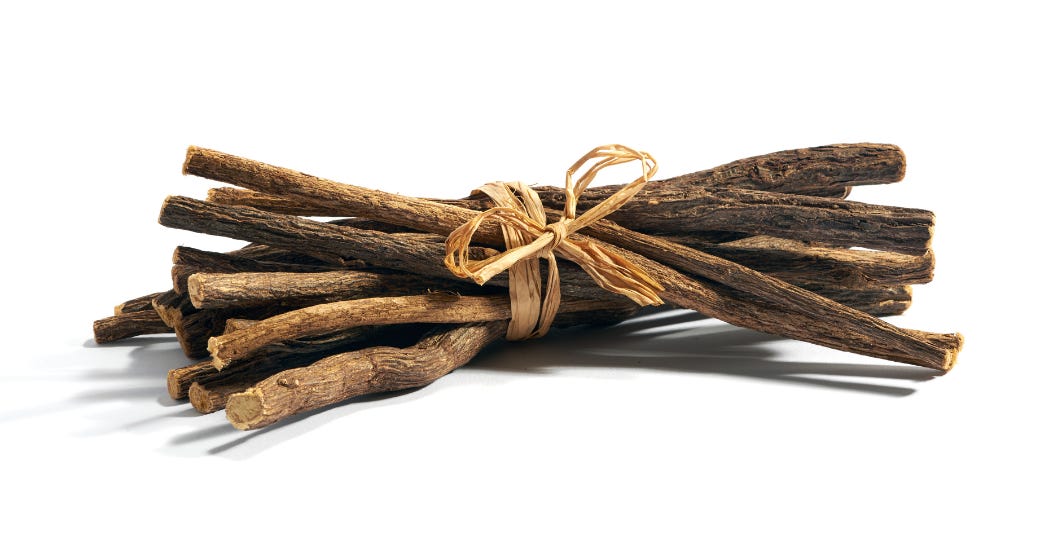
There are roots that teach us about time. Licorice is one of them - a plant so ancient, so valued, that empires reached for her. She arrives in your hands in two forms: sliced discs, thin-skinned and ready to steep; or whole sticks, dark and resilient, asking to be chewed slowly, dissolved gradually. Both are medicine. Both remember.
Her Latin name, Glycyrrhiza glabra, means “sweet root” - a name earned across continents, across centuries. She is not a plant that whispers. She is a plant that teaches through sweetness, through persistence, through the quiet work of restoration.
Healing Properties
Licorice root is traditionally used and commonly chosen to support:
Nervous system resilience - particularly during periods of depletion or prolonged stress; she is considered an adaptogenic ally that helps the body find balance rather than stimulate
Adrenal nourishment - supporting the glands responsible for stress response and energy regulation
Digestive ease - soothing inflammation in the digestive tract and supporting healthy stomach function
Throat and respiratory support - both as a direct soother and immune ally; historically chewed as a lozenge
Anti-inflammatory actions - research suggests licorice compounds may help reduce systemic inflammation
Hormonal harmony - traditionally used to support women’s cyclical health and ease transitions
Liver support - gently supporting detoxification pathways
Energetics
Warm, sweet, grounding, moistening.
Licorice feels like “glue” - it binds other herbs together, harmonizes disparate energies, and brings sweetness (both literal and metaphorical) to bitter or difficult work. She is rebuilding medicine; she asks for patience and consistency rather than quick fixes.
If you’re depleted, it says: rest here with me. If you’re scattered, it says: let me help you cohere. If you’re overextended, it says: I will help your body remember how to resource itself.
Folklore and Cosmology
Licorice’s story spans continents and millennia - a rare plant ally revered equally across vastly different traditions.
Ancient Egypt and Sumeria
The earliest written records of licorice appear in Sumerian cuneiform tablets (c. 2300 BCE) - listed among the most valued healing plants. Egyptian tombs held licorice root, placed there as medicine for the afterlife. Cleopatra was said to favor it as a beauty ally. The root was precious enough to be traded like gold.
Chinese Medicine
In Traditional Chinese Medicine, licorice (Gan Cao, or “sweet herb”) holds a place of profound respect. She is called the “diplomat” herb - the plant that harmonizes all others, helping them work together without conflict. In Chinese herbal formulas, licorice often appears as a unifier, a peacemaker, a plant that ensures no herb is working against another. She is considered cooling to neutral, moistening - a balm to dryness and heat.
The Chinese understood her as a plant of deep restoration, suited to those who have given too much, who are running on fumes, who have forgotten their own sweetness.
Ayurvedic Tradition
In Ayurveda, licorice (Yashtimadhu) is classified as a rasayana - a rejuvenative, a plant that rebuilds the body’s fundamental vitality. She is pacifying to Vata (the dry, anxious, scattered dosha) and Pitta (the fiery, irritable, inflamed dosha). She is sweet, warming, and deeply nourishing - a plant for those whose inner fire has burned too bright and now needs gentle fuel.
European Folk Herbalism
In Germanic and Northern European traditions, licorice arrived through trade routes and settled into folk practice as a women’s ally, a throat soother, and a plant for “sweetening” bitter medicines. Her roots were chewed, brewed into waters, and included in cough remedies. The plant became beloved enough that licorice sticks became a folk sweet - a medicine that tastes like care.
The Freya Connection
In Norse cosmology, Freya - goddess of love, fertility, and abundance - embodies the principle of gefa, or gift. Licorice, with her sweetness and her capacity to nourish deeply without forcing, carries this same energy. She is a plant that gives - of her sweetness, her medicine, her harmonizing presence. She asks nothing in return but consistency and respect.
Affirmation
I welcome sweetness as medicine. I rebuild with patience. I allow myself to be nourished, held, and restored. My depleted parts are invited home.
Plant Profile
Common Name: Licorice Root
Latin Name: Glycyrrhiza glabra
Plant Family: Fabaceae (Legume)
Part Used: Root (sliced or whole)
Native to: Mediterranean region, Western Asia
Key Constituents: Glycyrrhizin, flavonoids, polysaccharides, coumarins
Taste: Sweet, slightly bitter undertone, warming
Forms Carried at Nornir: Sliced root, whole sticks
Traditional Uses
Daily nervous system and adrenal support during stress or recovery
Throat soother - chewed as a lozenge or steeped as a throat coat tea
Digestive harmonizer - especially for those with sensitive or inflamed digestion
Women’s ally - supporting hormonal transitions and cyclical health
Stress recovery - particularly for those who have pushed themselves beyond capacity
Formula harmonizer - added to herbal blends to unite and smooth their action
Long-term vitality building - used consistently over weeks and months for deep restoration
Taste and Energetics
Deep, earthy sweetness with a subtle bitter undertone. The flavor unfolds slowly - first sweet, then grounding, then warming. Chewing a whole stick releases oils gradually; steeping sliced root creates a thick, almost creamy tea. The texture of her medicine matches her message: slow, persistent, deeply nourishing.
Suggested Use
Steep (Sliced Root): 1 teaspoon sliced licorice root per cup of water. Simmer gently 10-15 minutes. Drink 1-2 cups daily, or as part of a longer herbal blend. Consistency over time is where her medicine lives.
Chew (Whole Sticks): Place a whole stick in your mouth and allow it to soften and dissolve slowly. This is throat medicine, a centering practice, a small daily ritual of sweetness. One stick can last 20-30 minutes of gentle chewing.
In Blends: Licorice harmonizes well with other nervines (like chamomile, lemon balm, rose) and with other adaptogens (like ashwagandha, reishi). She softens bitter herbs and helps them work together.
Cautions and Important Notes
Licorice root is powerful medicine, and her gifts come with responsibilities. Please read carefully.
Do Not Use If You:
Have high blood pressure or take blood pressure medication - Licorice can raise blood pressure, especially with regular use. If you have hypertension or take medication for it, consult your healthcare provider before using licorice.
Take potassium-depleting medications (diuretics, certain steroids) - Licorice can further deplete potassium levels, creating serious imbalances. This combination requires medical oversight.
Have a history of hypokalemia (low potassium) - Licorice can lower potassium further.
Are pregnant or nursing - Licorice should be avoided during pregnancy and while breastfeeding. There is insufficient safety data, and some research suggests potential effects on fetal development.
Have heart conditions, kidney disease, or liver disease - Licorice affects fluid and electrolyte balance. These conditions require medical guidance.
Take medications for blood clotting or have bleeding disorders - Licorice may interact with anticoagulants.
Have certain hormonal conditions (estrogen-sensitive cancers, endometriosis, PCOS) - Licorice has mild estrogenic activity and should be used with caution. Consult your healthcare provider.
Use With Caution If You:
Take corticosteroids - The combination may increase the risk of side effects.
Have diabetes - Licorice may affect blood sugar levels; monitor closely.
Are taking any prescription medications - Licorice can interact with many drugs, including digoxin, medications that affect potassium, and certain antihypertensives. Ask your provider or pharmacist.
Duration Matters:
Long-term, daily use of licorice (beyond 4-6 weeks of continuous use) should be done under the guidance of a qualified herbalist or healthcare provider.
Licorice is best used seasonally or cyclically rather than indefinitely.
If you’re building adrenal support, consider working with a practitioner to create a rotating herbal protocol.
If You Experience:
Swelling, headaches, shortness of breath, or unusual fatigue while using licorice - stop use and consult your healthcare provider immediately.
FDA Disclaimer
These statements have not been evaluated by the FDA. This product is not intended to diagnose, treat, cure, or prevent any disease. Consult your healthcare provider before use, especially if you are pregnant, nursing, taking medications, or have a medical condition. Licorice root can interact with many medications and medical conditions; professional guidance is strongly advised.